News · 28 November 2026
From camera
to cortex.
In a single day, our AI beat every comparable published system at three flagship tests of brain-inspired computing: reading human movement from a camera that sees in microseconds, reading a monkey’s hand movements straight from its brain cells, and forecasting a chaotic system long after the data stops. It is one technology — AI that computes with time, like the brain — and it now beats the published references on 38 public benchmarks in our own tests, each against a system built for that one task: the kind of AI that drones, robots, smart glasses and brain–computer interfaces will run on.
The brain decoder is the camera model’s own deep reader, moved into neuroscience that morning; by the afternoon it had passed every published real-time decoder. By the evening the same reader had taken the third test.
A camera that sees in microseconds
An event camera doesn’t take pictures. Each pixel reports the instant its light changes, timed to the microsecond, while an ordinary camera looks 30 times a second and blurs everything in between. For machines that move fast, that is a different league: no motion blur, shadows and bright sunlight in the same view, and a fraction of the data and power.
That makes event cameras the eyes the next generation of drones needs: drones that fly fast and low, in the dark, and react to an obstacle in milliseconds instead of a frame too late. Sony and Samsung build event sensors, and robots, cars and smart glasses are adopting them. What they have lacked is AI that reads their microsecond timing directly instead of forcing it back into frames.
The standard test is IBM’s DVS128 Gesture: eleven hand and arm gestures, scored on six people the AI has never seen. Ours gets 96.64% right. The best published system tested without peeking at the answers scores 96.53%, and IBM’s original system scored 94.59%.
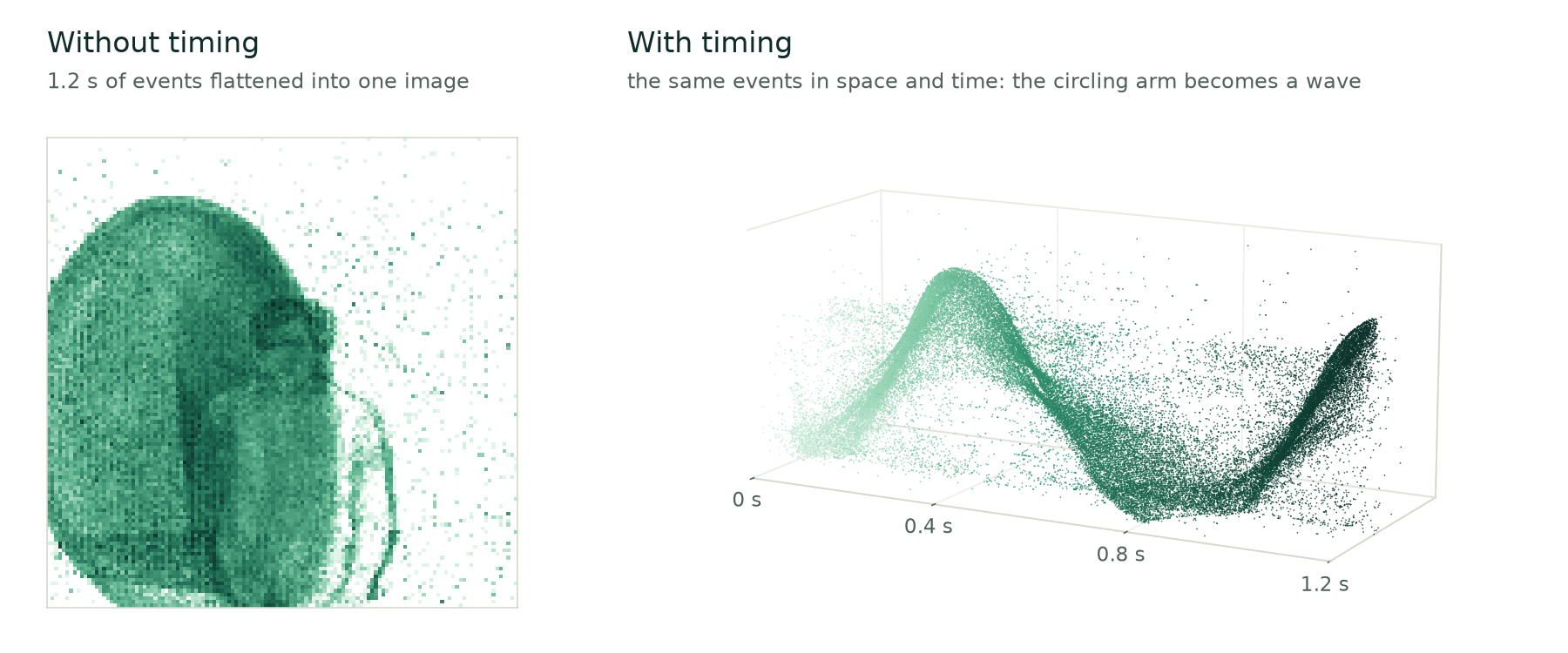
Real data, not an illustration: one DVS128 Gesture test recording of a person circling their right arm, 1.2 seconds of the camera’s raw events, with isolated sensor-noise events removed. Left: the events piled into one image, their timing discarded. Right: the same events with their timing kept, and the arm’s circles become a wave through time. Our models read the timing.
Reading the brain in real time
In the second test, electrodes recorded neurons in the motor cortex of two monkeys as they reached for targets. Every 4 milliseconds, using only spikes that have already happened, the AI must say how fast and which way the hand is moving. That is the core job of a brain–computer interface. In clinical trials, such interfaces already let people with paralysis move a cursor or a robotic arm.
Our decoder explains 71% of the variation in the hand’s speed and direction (R² 0.7139), more than any published real-time decoder. That puts it above every score on the NeuroBench leaderboard, where the best is 0.71 (our NeuroBench submissions are pending), and above 0.698 for bigRSNN, the strongest system tested without peeking.
It fits in a small package, too. A compact version, trained like bigRSNN with recordings from extra days, scores 0.7161 with fewer arithmetic operations per step and under a third of the memory: 1.50 MB against 4.83 MB.
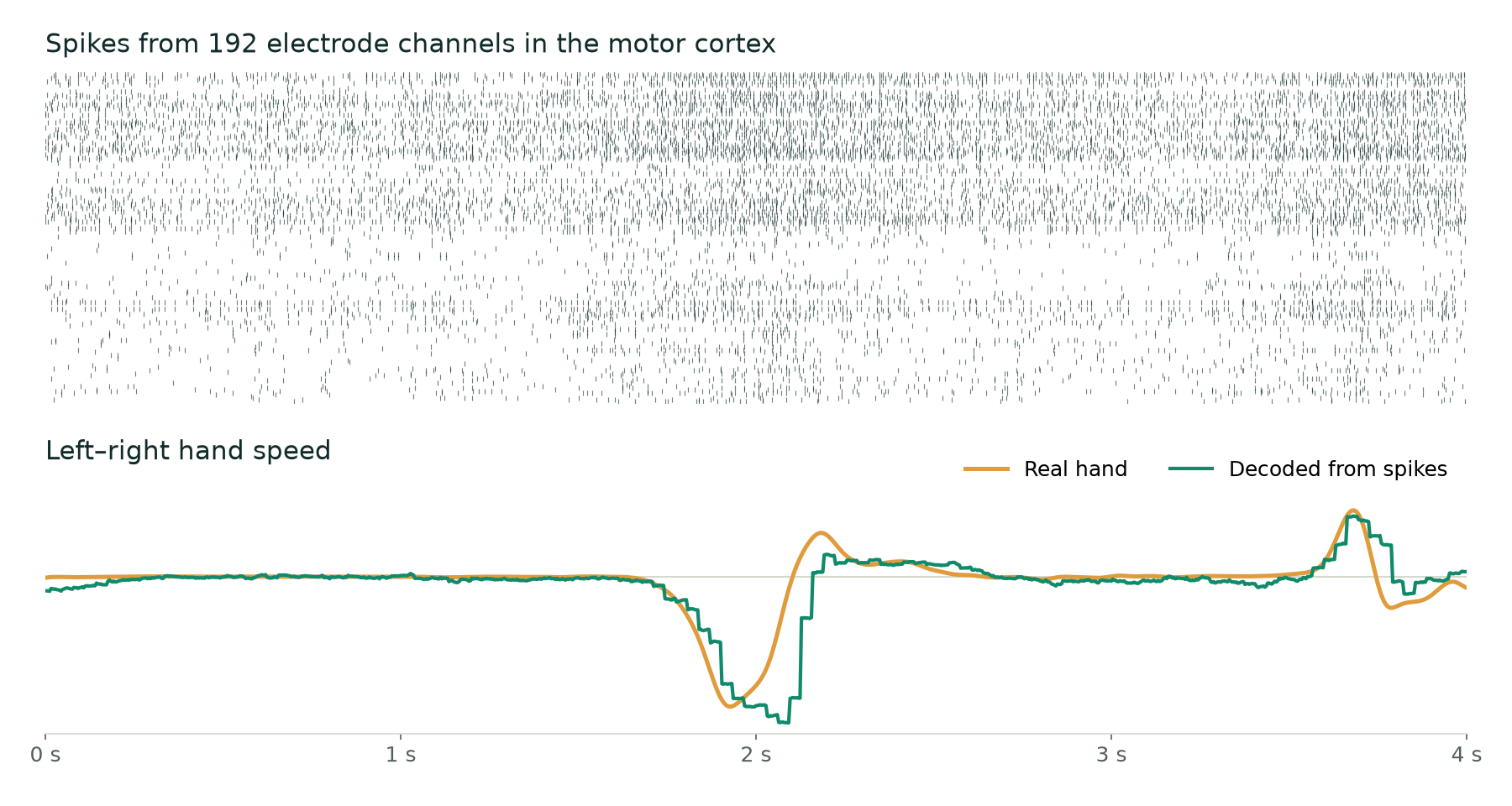
Real data: four seconds of the official test (recording session loco_20170210_03). Top: every spike recorded on 192 electrode channels. Bottom: the hand’s left–right speed (amber) and our compact decoder’s reading of it (green), made every 4 ms from past spikes only. The stretch was chosen by rule as a typical one: among the busiest quarter of four-second windows, the one whose accuracy matches the session’s (R² 0.70).
Forecasting chaos
The third test is a classic of chaos theory: the Mackey-Glass system, first written down to describe the rhythm of blood-cell production. Its future depends on its own past in a way that makes tiny errors explode. The AI sees 750 steps of it and must then continue alone for 750 more, feeding on its own predictions, from thirty different starting points.
Our forecasts miss by 11.6% on average (sMAPE 11.59; lower is better). The best entry on the NeuroBench leaderboard, an LSTM tuned on this very test, misses by 13.4%, and GLE, a brain-inspired model published in Nature Communications in 2025, by 14.3%. A version cut down to the LSTM’s memory still wins, at 13.1%.
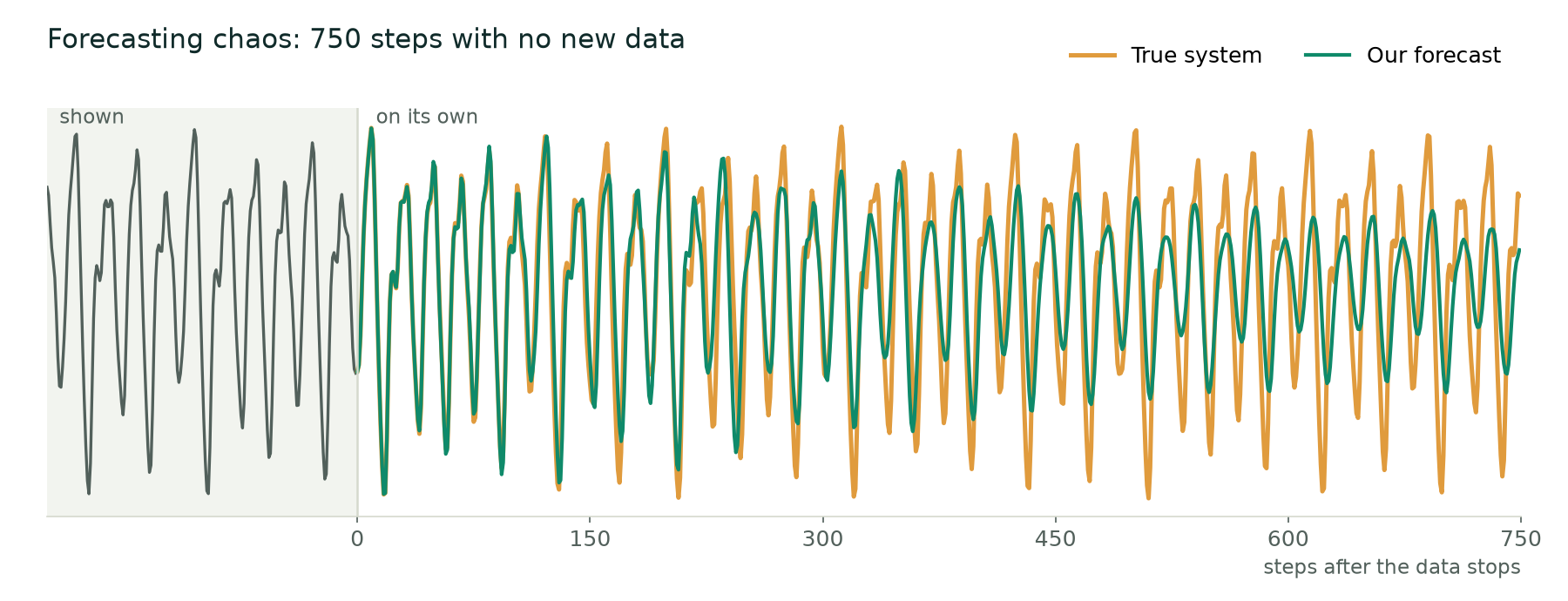
Real data: one of the thirty official runs, the one whose error is closest to the average (11.6%). Grey: the last 200 steps the model was shown. Then the true system (amber) and our forecast (green), made with no new data. It holds the true signal closely for the first stretch and keeps its rhythm after that, where the exact peaks of a chaotic system become unpredictable for any forecaster.
Chaotic systems are everywhere: weather, power grids, heart rhythms. A forecaster that keeps its bearings long after the data stops is what planning in them needs.
Why it matters
Today’s AI sees the world in snapshots, video frames and text tokens, and recomputes everything even when almost nothing has changed. Real sensors and real brains don’t work that way. They speak in events, and the meaning is in the timing.
Our models compute with that timing directly. That is why one family of models could win all three: a camera, a cortex and a chaotic system share no data, but they share a language.
- Machines that react. Drones, robots, cars and glasses that see motion as it happens.
- Brain–computer interfaces. Decoders that are accurate, real-time and small.
- Low-power chips. We design for event-driven hardware, where the parts of a model that aren’t firing cost nothing.
That is how one family of models now beats the published references on 38 public benchmarks in our own tests, from hospital records and industrial control loops to earthquakes, each time against a system that was designed and tuned for that one task.
Measured the hard way
We write down each model and how it will be scored before it sees a test, choose models only on practice data, and report every test run. The full record is on our results page.
Build it with us
We are raising our seed round and hiring the people who will take this from benchmarks to products and our own chips. We are an AI-first team: agents write much of our code and run much of our compute, so each person here steers far more than one person’s work. Investors: request access. Researchers and engineers: see the open roles. Or write to info@hypersleep.ai.
| Hypersleep | Best comparable published | Other reference | |
|---|---|---|---|
| DVS128 Gesture, six unseen people, accuracy | 96.64% | 96.53% (PLIF) | 94.59% (IBM’s original system) |
| NeuroBench primate reaching, six recording sessions, R² | 0.7139 | 0.698 (bigRSNN) | 0.71 (leaderboard top) |
| Same task, compact version | 0.7161, 1.50 MB | 0.698, 4.83 MB (bigRSNN) | |
| NeuroBench Mackey-Glass, 30 runs, error (sMAPE, lower is better) | 11.59 | 14.25 (GLE) | 13.37 (LSTM, leaderboard top, tuned on the test) |
Sources: DVS128 Gesture, Amir et al., CVPR 2017 (IBM Research). NeuroBench primate reaching, recordings by O’Doherty, Cardoso, Makin and Sabes (2017), and NeuroBench Mackey-Glass (tau 17), each scored with the official NeuroBench evaluator; GLE, Ellenberger et al., Nature Communications 2025. Full comparisons on the results page.