News · 29 November 2026
Reading people
in motion.
Our AI now recognises everyday human actions from an event camera more accurately than any comparable published system: it gets 76.5% right on the official test, with four people it had never seen, against 69.9% for the best published result. It is our 39th benchmark win and our second for event cameras in two days, the sensors that let drones, robots and smart buildings see motion in microseconds, in glare and dim light, without taking pictures.
The day before, the same technology won the standard hand-gesture test. Here it carried over to whole bodies, to a camera with five and a half times the pixels and to fifty kinds of action.
Fifty actions, four strangers
THU-EACT-50-CHL, from Tsinghua University, is one of the hardest public tests for event cameras. Eighteen students perform 50 everyday actions, from walking and jumping to sitting down, opening an umbrella, putting on glasses and shaking hands. An event camera films them from the front, the sides and behind, in a long corridor and an open hall, under changing light. Fourteen people are for training. The test uses the other four, people the AI has never seen.
Many of the actions mirror each other in time. Sitting down and standing up pass through the same poses in opposite order; so do opening and closing an umbrella, and putting glasses on and taking them off. A single picture can’t tell them apart. The order of the movement decides, and that order is exactly what an event camera records. Video networks built for ordinary frames get only 41 to 51% right here.
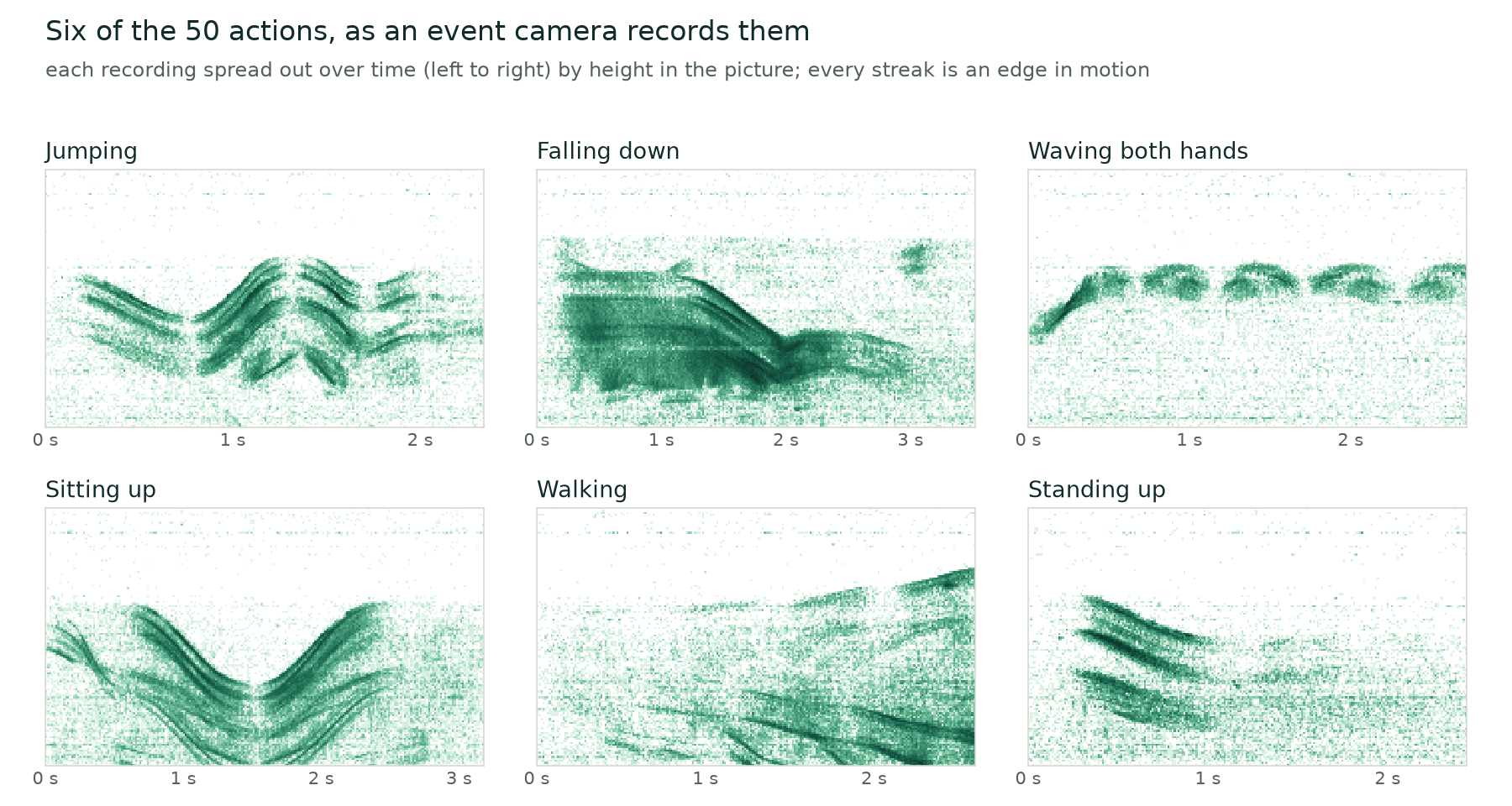
Real data, not an illustration: six recordings from the benchmark’s training set, one student on the front camera, the first recording of each action, with isolated sensor-noise events removed. Each panel spreads a recording out over time, left to right, by height in the picture; every streak is an edge in motion. Each action leaves its own signature in time, and our models read that timing directly.
Ahead of every comparable system
Our AI gets 76.5% of the test right, across three independent runs of 76.1, 76.3 and 77.2%. The best published system trained on the same data, HoloEv-Net, scores 69.9%. CSTR, an October 2026 preprint, scores 68.6%, and SMV-EAR, presented at CVPR 2026, 66.7%. Ours does it with 1.56 million parameters, an eighth of HoloEv-Net’s 12.5 million.
One system goes further by first training on DailyDVS-200, a separate collection of 22,000 event-camera recordings, and reaches 78.7%. We have not used that collection yet. It is our next step.
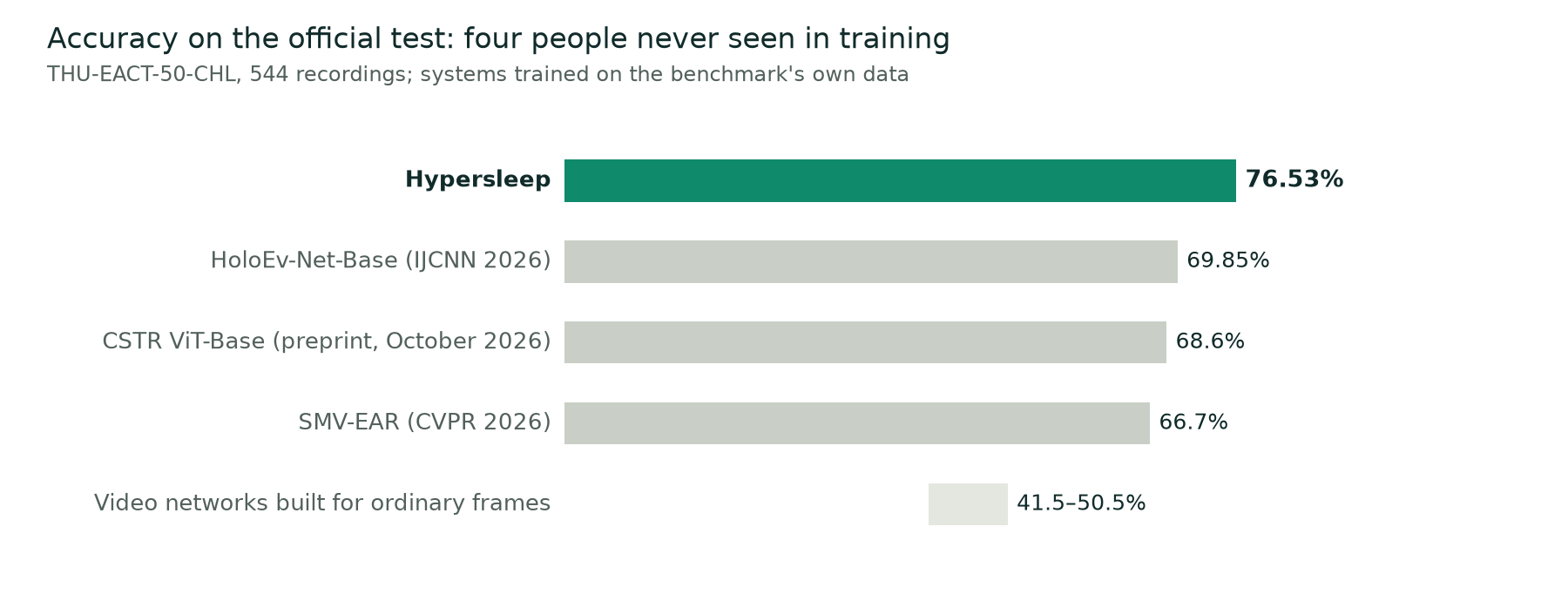
Accuracy on the official THU-EACT-50-CHL test: 544 recordings of four people never seen in training. Every system shown was trained on the benchmark’s own data; the published figures are each paper’s own.
Why it matters
Event cameras are where machine vision is going. They react in microseconds, see in glare and dim light, draw little power and record motion rather than faces and scenes. That makes them the natural eyes for fast drones and robots, for cars and smart glasses, and for buildings that must understand what is happening without filming anyone.
To work around people, those machines must understand what people do: a robot that sees you reach for something, a drone that answers a wave, a factory floor that sees where everyone is moving. In two days our models have beaten the published state of the art on two very different event-camera tests, hands and whole bodies, recorded on two different cameras. Each new application starts from a model that already wins.
That makes 39 public benchmarks on which, in our own tests, our models beat the published reference, each time against a system built for that one task.
Measured the hard way
We chose the model by training on some of the fourteen training people and testing on the rest, wrote down the exact configuration before the test was opened, and read the test once. Every test run is on our results page.
Build it with us
We are raising our seed round and hiring the people who will take this from benchmarks to products and our own chips. We are an AI-first team: agents write much of our code and run much of our compute, so each person here steers far more than one person’s work. Investors: request access. Researchers and engineers: see the open roles. Or write to info@hypersleep.ai.
| Hypersleep | Published | |
|---|---|---|
| THU-EACT-50-CHL, four unseen people, accuracy | 76.53% (1.56M parameters) | 69.85% HoloEv-Net-Base (12.5M parameters); 68.6% CSTR ViT-Base; 66.7% SMV-EAR |
| Same test, after extra training on DailyDVS-200 | not yet tested | 78.7% CSTR ViT-Tiny |
Sources: THU-EACT-50-CHL, Gao et al., “Action Recognition and Benchmark Using Event Cameras”, IEEE TPAMI 2023 (Tsinghua University). HoloEv-Net, IJCNN 2026 (arXiv 2602.04182). CSTR, arXiv 2610.13856. SMV-EAR, CVPR 2026 (arXiv 2601.17391). Full comparisons on the results page.